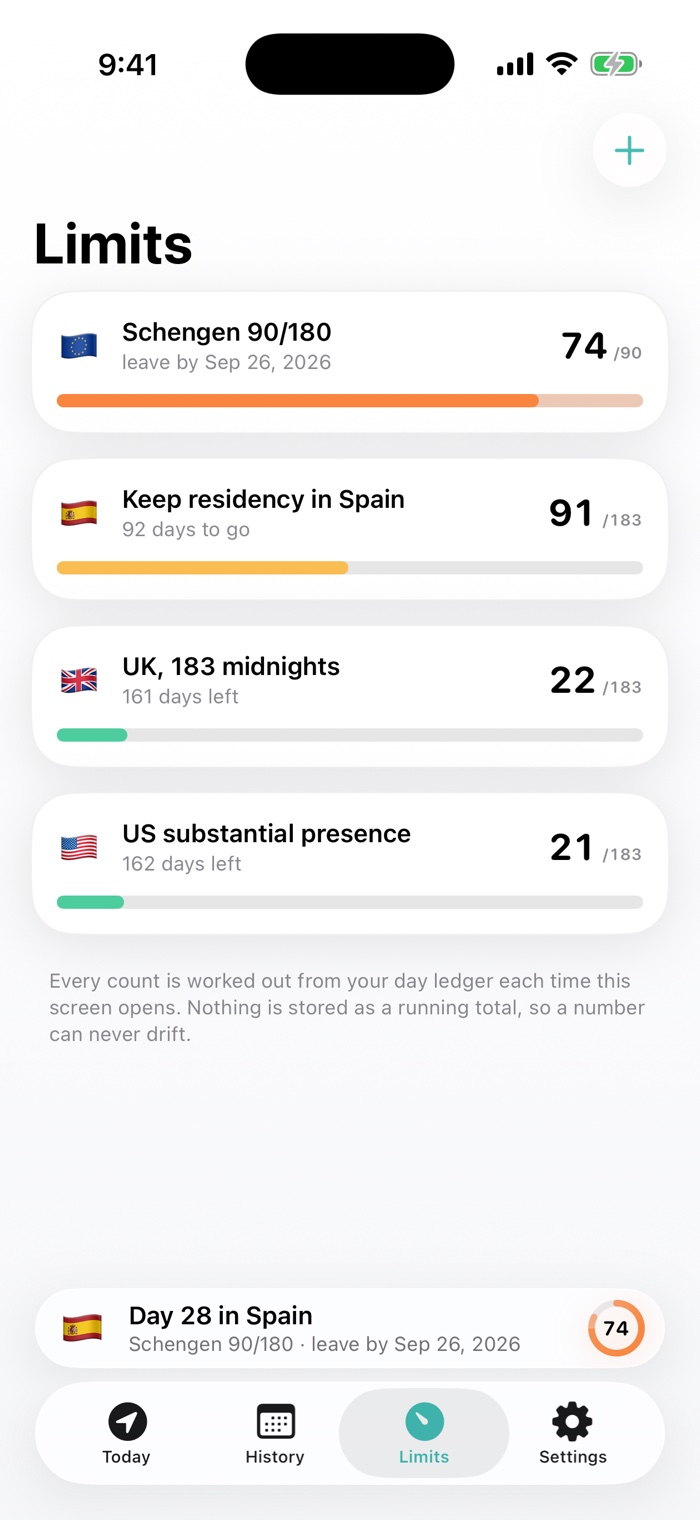
Stint keeps a day by day record of which country you were in, and measures it against the limits that actually bite: Schengen, a tax year, a visa, a residency minimum.
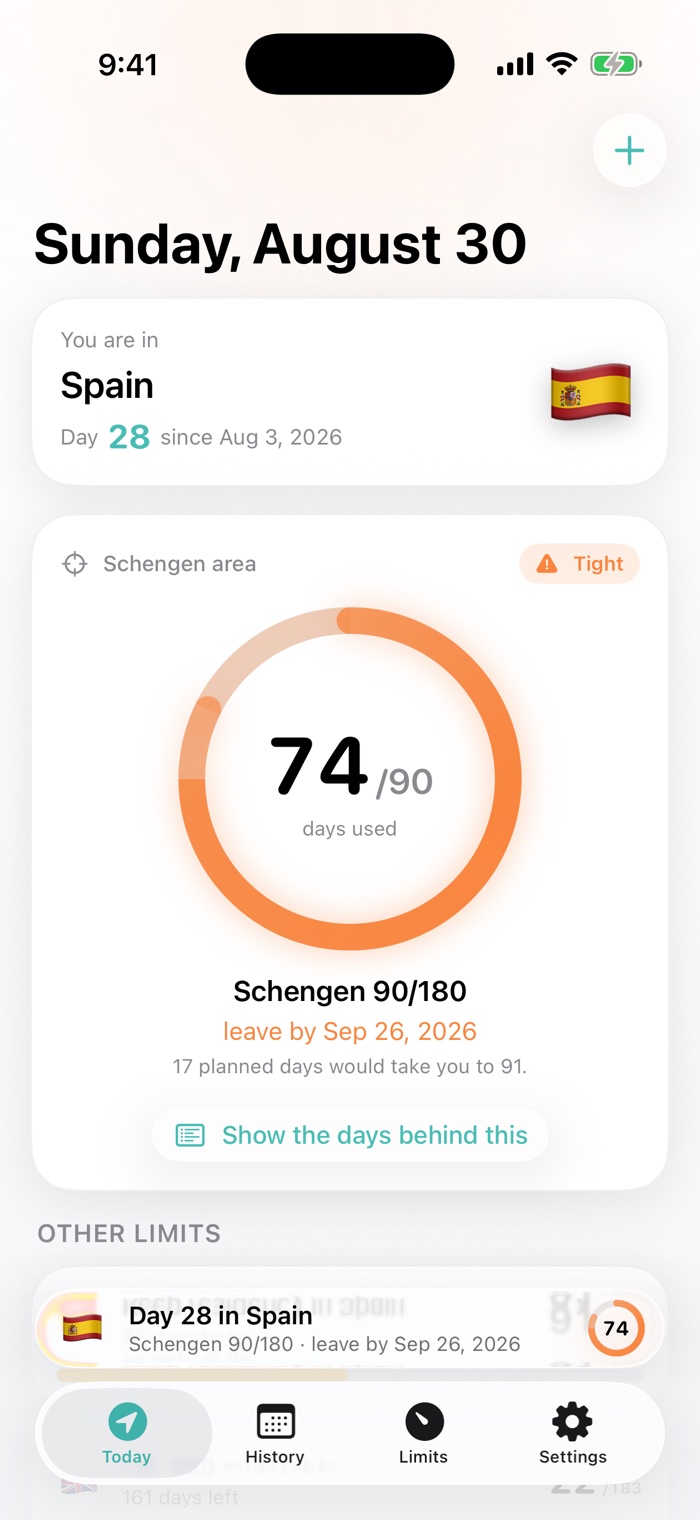
19,99 € once no subscription On the App Store. iPhone and iPad, iOS 18 or later.74 of 90 days used
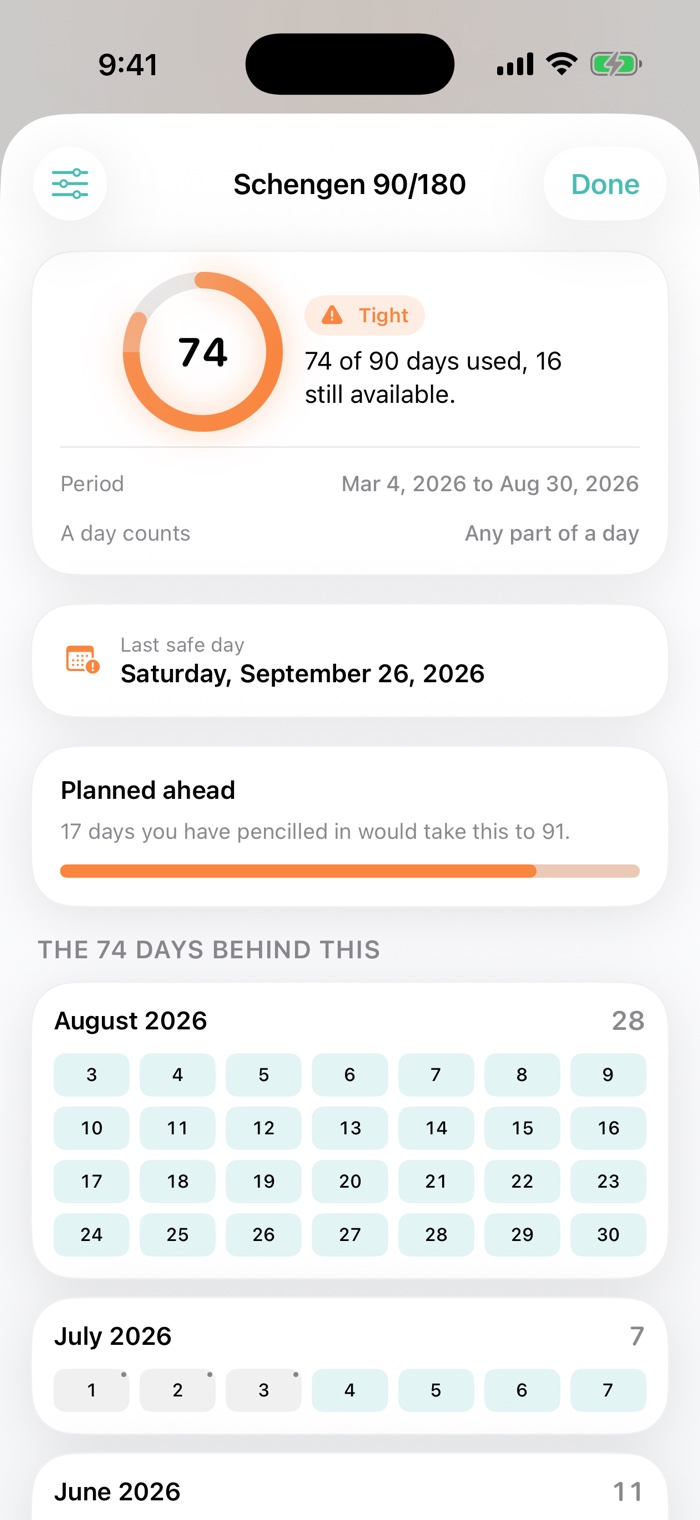
Coloured in as the days are recorded
The date to leave by, not just the count
106 days in Spain, on the calendar year

What it counts
They are genuinely different rules, not one rule with different numbers. Run as many at once as you need: a Schengen count and a tax year count are different questions, and the answer to one tells you nothing about the other.
If you only want to check one trip against the 90/180 rule right now, there is a free Schengen calculator on this site that does it in the browser.
A real rolling window that sheds old days as they age, not a counter that resets on a date.
In any country, on the calendar year or on a tax year of its own, like the UK's April to April.
A day only counts if you were in the country at midnight, which is a different total from the same trip.
This year in full, last year at a third, the one before at a sixth, weighted across the three.
A fixed number of days between two fixed dates, for the stamp you actually hold.
Days you have to reach, not avoid. Here the risk is running out of calendar rather than overstaying.
Nothing is a running total
Each figure is recomputed from the day ledger every time you look at it. Tap it and you get the exact days behind it, month by month, and where each one came from.
The tracker
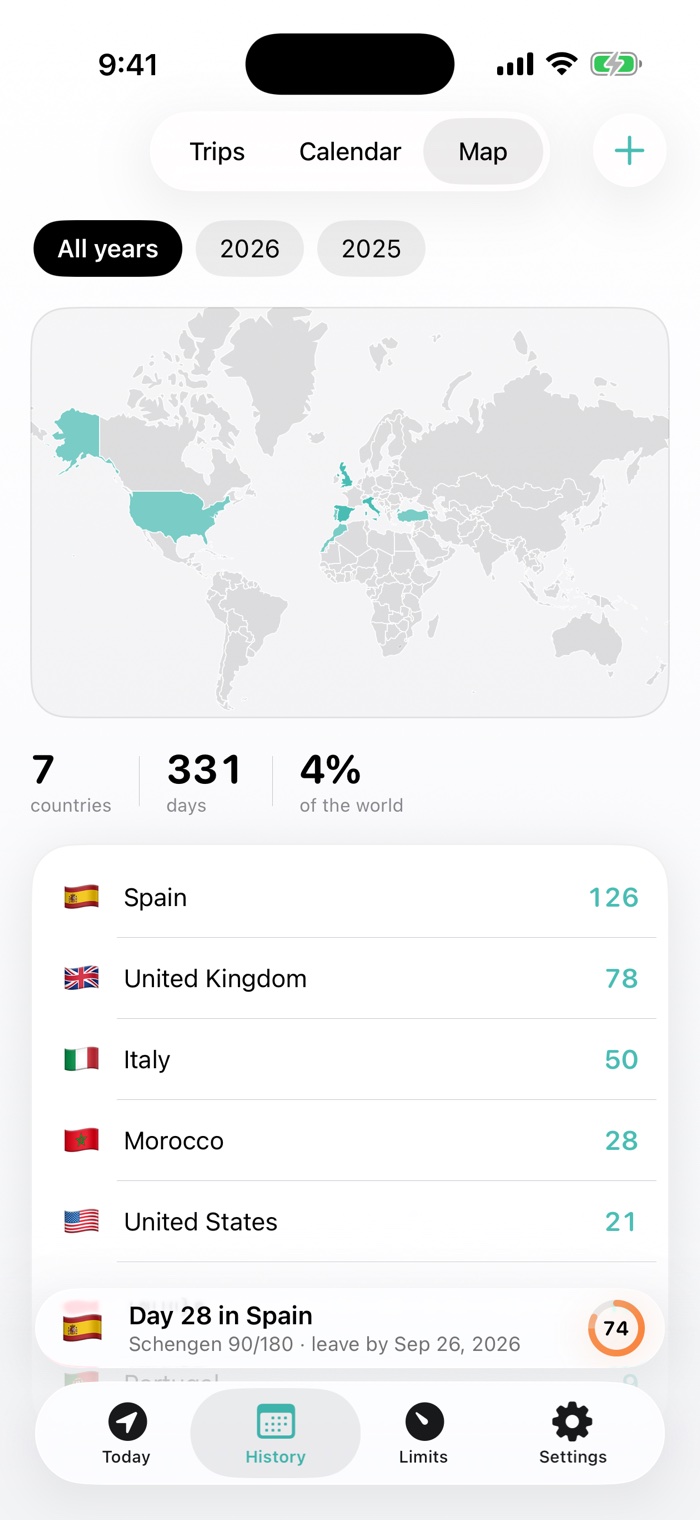
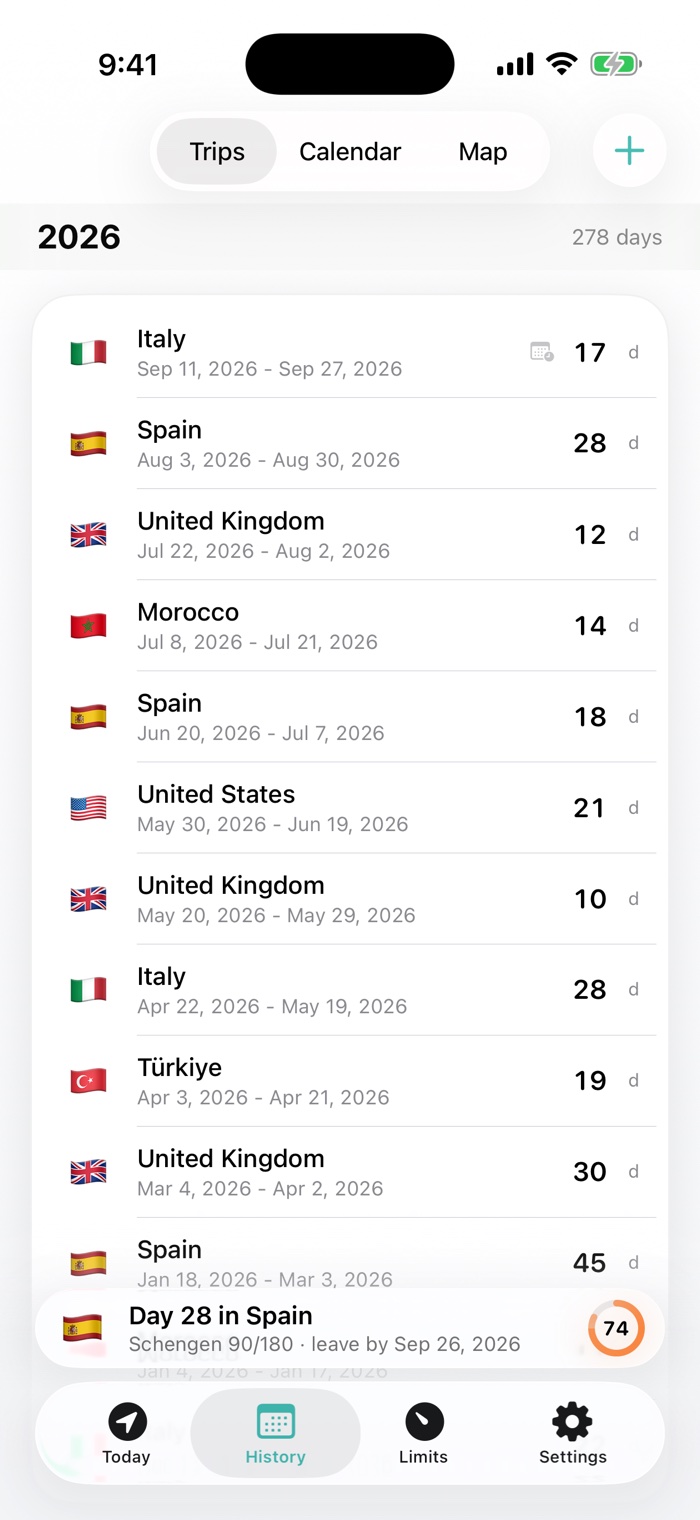
Stint reads significant location changes and visits in the background, and turns each one into a country. It runs on the low power side of the system, so it is not the app draining your battery.
The rest of it
Price
The apps this replaces charge a subscription to count days that never stop being counted. Stint charges once. The free tier is meant to be usable on its own, not a countdown to a wall.
Stint is a tool for keeping records, not tax advice. Check anything that matters with a professional.
Privacy policy
Last updated 30 August 2026.
Stint has no account and no advertising. Your day ledger lives on your iPhone, and, if you turn on sync, in your own private iCloud. Nothing about where you have been is ever sent to us.
With your permission, Stint reads significant location changes and visits, and turns each one into a country. This happens on your device and the result is stored on your device.
To turn a coordinate into a country name, Stint asks Apple's map service, so that coordinate is sent to Apple and handled under Apple's privacy policy. Answers are cached, so a stay in one place is usually a single lookup. Nothing else receives your location.
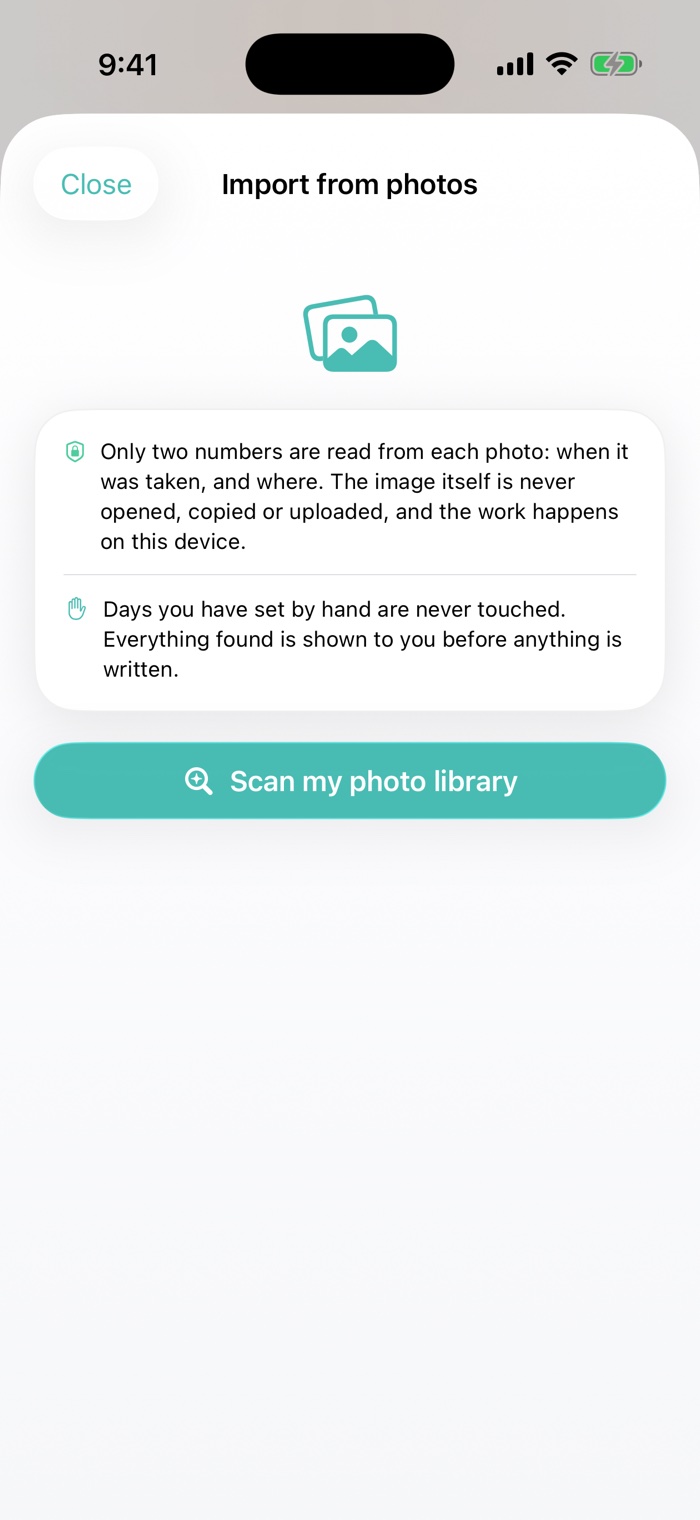
If you use the photo import, Stint reads the date and coordinates stored in your photos to reconstruct where you were. This runs on your device. Your photos are not uploaded, copied or kept.
Sync uses your own private iCloud database, through Apple's CloudKit. It is your Apple Account, not ours: we cannot read it, and neither can anyone else you have not shared your Apple Account with. Turning sync off leaves the copy on your device untouched.
Stint reports how the app is used, so we can tell which parts of it work: a screen being opened, a permission being granted or refused, an import finishing, a purchase going through or failing. These reports go to Logga, our own service, under a random identifier that this app creates on your phone. It is not your Apple Account, it is not the advertising identifier, and it is not linked to your name.
What these reports never contain: a country, a coordinate, a date you travelled, a photo, or anything from your ledger. Where a number would be revealing, it is sent as a band rather than a value, so a report can say that days have been recorded without saying how many or which.
The purchase is made through the App Store. Apple handles the payment, and we never see your card, your name or your address. To check that the purchase is valid and to restore it on your other devices, the transaction is verified by RevenueCat, our purchase provider, which receives the anonymous identifier of that transaction and nothing that identifies you.
Everything is yours: export it as CSV or PDF at any time. Settings has a control that erases the whole ledger, and deleting the app removes the copy on that device. If you used iCloud sync, turning it off and deleting the app on every device removes it from your iCloud too.
Stint is not aimed at children and collects nothing that identifies anyone.
If this policy changes, the date above changes with it. Questions, or a request about your data: [email protected].
 Stint
Stint